
By Your Phoenix Attorney • 2026-08-28
What Happens at an Arraignment in Arizona?
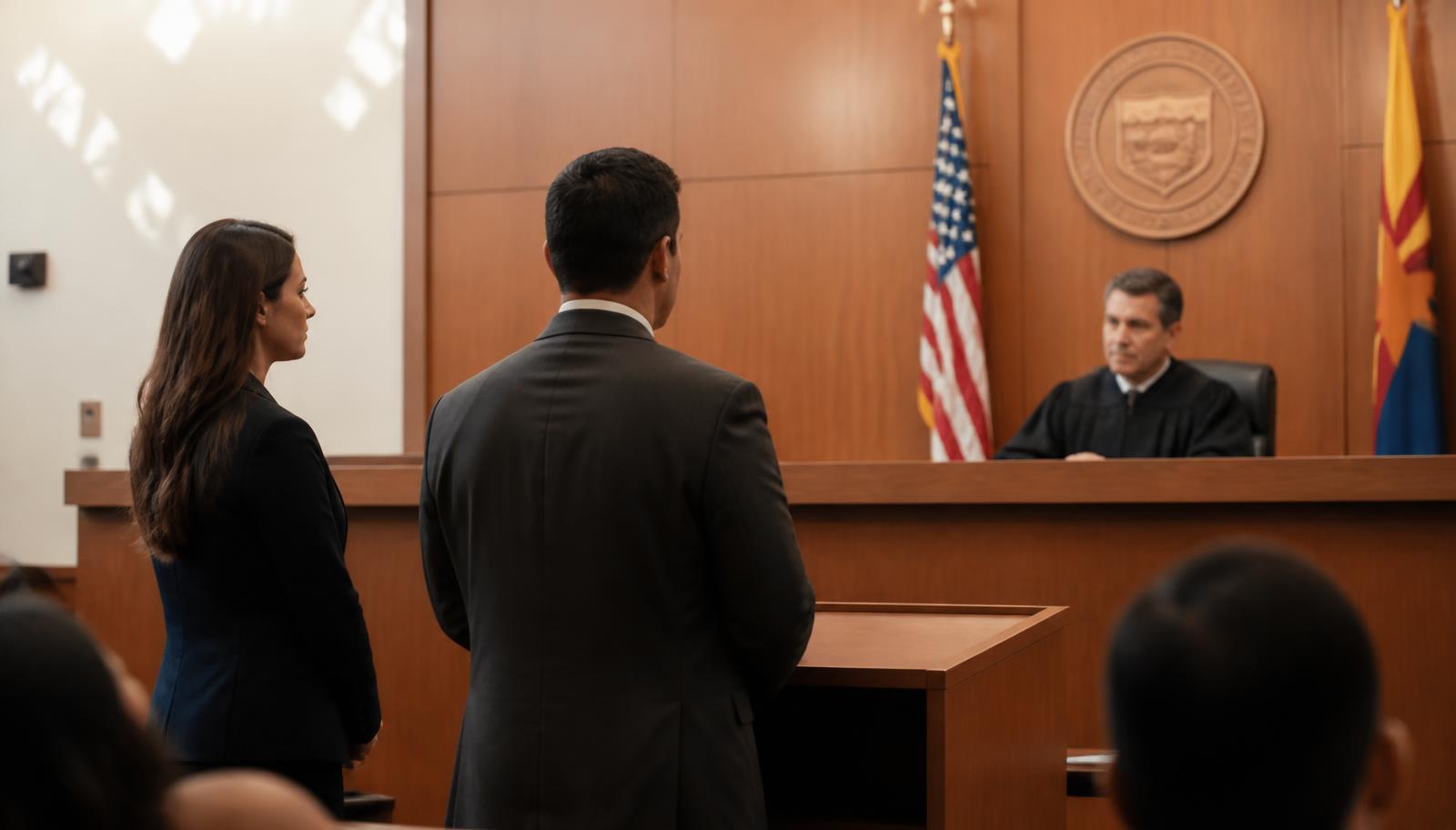
An arraignment in Arizona is a short hearing where the court formally tells you what you are charged with, you enter a plea — almost always not guilty — and the judge sets or reviews your release conditions and your next court date. It usually takes only a few minutes. It is not a trial, no evidence is presented, and nobody decides whether you are guilty that day.
People walk into arraignment expecting to explain themselves. That is the single most common misunderstanding we see, and it is worth clearing up before you go.
When does your arraignment happen?
Timing depends on whether you are in custody and which court is handling the case.
- If you were arrested and are still in custody, an initial appearance happens quickly — typically within 24 hours — where release conditions are set. Arraignment follows shortly after.
- If you were cited and released, you will get a date by mail or on your citation, usually a few weeks out.
- In felony cases in Superior Court, arraignment generally follows an indictment by a grand jury or a preliminary hearing.
- In misdemeanor cases in a justice or municipal court, arraignment is often your first appearance.
Missing an arraignment is serious. The court can issue a warrant, and a failure to appear can become its own charge. If you cannot get there, that is something to sort out with a lawyer before the date, not after.
What actually happens in the courtroom?
The mechanics are straightforward. The judge confirms who you are and your address, reads or summarizes the charges, and advises you of your rights, including the right to counsel and the right to remain silent. Then you enter a plea.
Almost every defense attorney in Arizona will tell you to plead not guilty at arraignment, for a practical reason. At that point neither you nor your lawyer has seen the state's file — the police reports, the video, the lab work, and the witness statements. Pleading not guilty is not a claim about the facts; it preserves your ability to see the evidence, file motions, and negotiate from an informed position. You can change a plea later. You cannot undo a guilty plea entered before anyone looked at the discovery.
The judge will also address release conditions — release on your own recognizance, bond, no-contact orders, travel restrictions, and monitoring in some DUI cases — and then set your next date.
What should you do — and not do — at arraignment?
- Show up early, dress like you would for a job interview, and bring your paperwork.
- Do not try to explain what happened. The judge is not there to hear your side, the prosecutor is in the room, and anything you say can be used later.
- Do not discuss your case with anyone in the hallway. That includes other defendants.
- Do answer the judge's direct questions about your name, address, and understanding of your rights.
- Do tell the court if you do not understand something or need an interpreter.
- Have an attorney with you, or at minimum have spoken to one before you walk in.
That last point matters more than people expect, because release conditions get set at this hearing and are much easier to shape at the start than to modify later.
How can an attorney help before arraignment?
A pattern we see often, described generally and without identifying details, is someone facing a first-time charge who arrives at arraignment alone, planning to tell the judge it was all a misunderstanding and get it cleared up that morning. That is not what the hearing is for, and it can create statements that are difficult to walk back.
Where counsel is retained before arraignment, the charging documents have already been reviewed, the release conditions to request are identified, and issues such as work schedules or travel obligations can be raised when the judge is setting those conditions. It is a short hearing, but it sets the terms you live under for the months that follow. Every case is different, and past results do not guarantee future outcomes.
Arraignment is not where cases are won
We do not want to oversell this hearing. Arraignment is procedural. Nothing is decided about guilt, no evidence is examined, and in many courts the whole thing is over in under five minutes. Some defendants appear by video or through counsel and never set foot in the courtroom.
In straightforward misdemeanor matters, people sometimes appear without a lawyer, enter a not guilty plea, get their next date, and retain counsel afterward without harming their case. That happens. The risk is not that arraignment is complicated — it is that people treat it as their chance to talk, and talking is what causes damage. If you take nothing else from this: enter not guilty, say very little, and get the discovery before you make any decisions.
Talk to a Phoenix criminal defense attorney before your arraignment
If you have an arraignment in Arizona coming up, a conversation beforehand changes how you walk into that room. Your Phoenix Attorney offers free consultations and is available 24/7 with a real attorney answering, not an answering service.
We handle criminal defense statewide, including DUI defense and domestic violence matters. We offer transparent flat fees, payment plans, bilingual Spanish support, and in-jail visits. What to do if you are arrested in Phoenix covers the steps before this one. Call 623-335-4014.
One thing worth knowing before your first appearance: if you do not show up, the judge will almost certainly issue a bench warrant, and in a felony matter the failure to appear is a separate felony charge. It is fixable, and it is far more fixable early. Read what happens if I miss a court date in Arizona.
Arraignment is also the point where most people start wondering how long all of this is going to take. It is worth knowing that arraignment sits near the beginning of the calendar, not the middle, and that most of the time in a case is spent in disclosure afterward. We lay out realistic ranges in how long a criminal case takes in Arizona.
Frequently asked questions
Can I plead guilty at my arraignment in Arizona?
You can, but it is rarely wise. At arraignment nobody has reviewed the state's evidence yet. A not guilty plea preserves every option, including a negotiated resolution later once the discovery has been examined. Speak with an attorney before entering any plea.
Do I have to appear in person at my arraignment?
It depends on the court and the charge. Some Arizona courts allow appearance by video, and in certain matters counsel can appear on your behalf or file a waiver of arraignment with a not guilty plea. Do not assume you can skip it — confirm with the court or your attorney, because failing to appear can result in a warrant.
How long does an arraignment take?
The hearing itself is usually a few minutes. The wait can be considerably longer, since courts often calendar many arraignments in the same block. Plan on being at the courthouse for a couple of hours even though your part is brief.
Need help with an Arizona arraignment? Call Your Phoenix Attorney at 623-335-4014 for a free consultation. We serve Phoenix, Scottsdale, Mesa, Gilbert, Glendale, Tucson and Paradise Valley — statewide Arizona.
This article is for general information only and is not legal advice. Every case turns on its specific facts. Speak with a licensed Arizona attorney about your situation.
Need help with this issue?
Call Your Phoenix Attorney at 623-335-4014 for a free consultation, or use the contact form.
About Your Phoenix Attorney
Aggressive Arizona criminal defense — Phoenix, Scottsdale, Mesa, Tucson & statewide.
- Address:
- 2999 N. 44th St., STE. 888, Phoenix, AZ 85018
- Phone:
- 623-335-4014
Find us around the web